

A floor that gives way under your step. A beam that yields under your thumb. Your load-bearing structure is sending you a signal — and that signal won't go away on its own. Every week of delay increases the damage and doubles the repair costs.
Do you recognise any of these signs?
Every week of delay increases the damage.
Why are load-bearing beams so vulnerable?
Wooden beams work invisibly. They are embedded in walls, floors and roofs — zones where moisture, insects and fungi can act undetected. The beam end, the part embedded in the wall, is the most critical point: it absorbs moisture and is the hardest to inspect.
Damage to load-bearing beams has four main causes: moisture infiltration and wood rot, wood-boring insects (woodworm or house longhorn beetle), dry rot or other fungi, and ageing under load. Multiple causes often act simultaneously.
6 signs you can observe yourself
1. Sagging or springy floor
Does the floor flex under your step, or feel slightly springy? The beam beneath has lost its load-bearing capacity. This is the most urgent signal.
2. Soft or crumbling wood fibres
Press your thumb into a visible beam. Does the wood give way or crumble? Wood rot is active. Healthy wood is hard and does not compress.
3. Cracks or splits along the grain
Surface cracks are normal in old wood. Deep, continuous splits — especially combined with moisture — indicate structural weakening.
4. Moisture stains or discolouration at the wall junction
The zone where the beam disappears into the wall is the weakest link. Dark stains, mould growth or peeling paint at beam ends are a clear warning sign.
5. Bore dust or holes in the wood
Fine sawdust beneath a beam, small round holes or a hollow sound when tapped indicate wood-boring insects — insects that hollow out the beam from within.
6. Movement or noise under load
Is the floor creaking more than usual? Do you feel vibration or lateral movement when walking? The structure is no longer carrying as it should.
Do you recognise one or more of these signs?
What are the risks if you do nothing?
Wood that loses its load-bearing capacity never recovers spontaneously. The consequences of delay are: increasing deflection of floors and roofs, settlement of the structure above, spread of dry rot or wood-boring insects to adjacent timber, and in serious cases: risk of collapse.
An early diagnosis costs a fraction of what structural repair requires afterwards.
How does a professional diagnosis work?
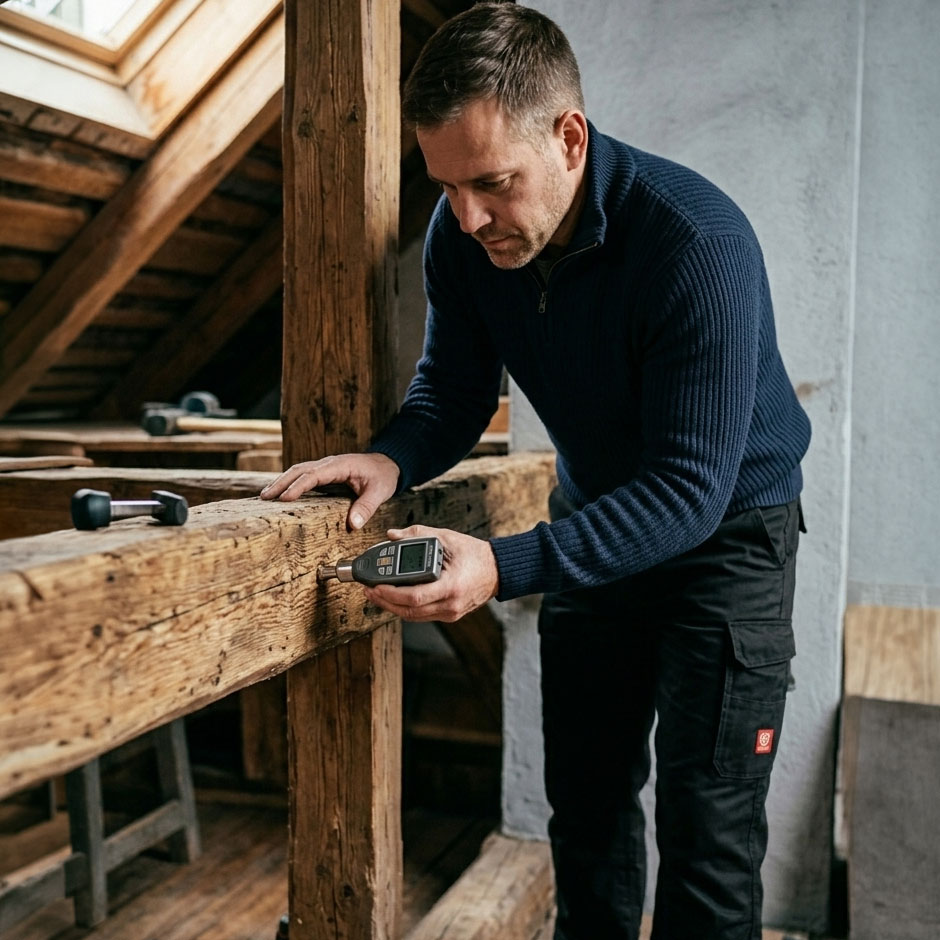
Protector carries out a technical inspection based on probe tests (hardness test), moisture measurements, wood structure analysis, detection of dry rot, wood rot or insects, inspection of beam ends in the wall, and assessment of load and deflection. On this basis, we draw up a repair plan, tailored to the severity and cause of the damage.
Repair methods: from reinforcement to replacement
Protector always applies the least invasive method, but those who wait inevitably move to the next column.
| Method | When? | Early intervention pays off |
|---|---|---|
| Beam end restoration (polymer composite) | Damp or rotted beam ends | Yes, prevents replacement |
| Timber injection & impregnation | Wood-boring insects, fungal prevention | Yes, stops further spread |
| Partial replacement / prosthetics | Severe localised damage | Partially, depending on severity |
| Full beam replacement | Irreversible structural damage | No, should have been done sooner |